This week we reviewed a number of transferable soft skills that come with working in teams and creating good work habits such as, Effective Communication, Strong Work Ethic, Positive Attitude, Time Management skills etc. After this review, there were a number of questions to follow up on which include improving my transferable soft skills, researching on Australian game companies and what is required to start an indie company. These topics will be researched and discussed throughout this research report.
Receiving criticism was a transferable soft skill that I wanted to improve on, this might be criticism from peers about work that I’ve completed or negative feedback from playtesters and players that play the game. The problem with me is that I have this mindset that I want absolutely everyone to like my game and because I of this I work extra hard in order to achieve this goal, the result is that if I do receive negative feedback my response is even worse because I put extra effort to create this thing, it is a vicious cycle and I wanted to explore some methods of dealing with criticism. The first and most obvious fix is to know that it is impossible for everyone to like your game and if the majority of players enjoy the experience why get hung up on the one player that doesn’t? Additionally, I should be able to draw in some valuable feedback from the player that doesn’t, they could see the game in a way that we aren’t able to. If the feedback is just a scathing review with no reasoning try and think of something like this, when you begin developing a game you generally have a target audience in mind, someone that would enjoy your game, so surely the opposite exists someone that absolutely loathes your game because of its mechanics or whatever, so keep this in mind when receiving negative feedback.
Additionally, I should be able to draw in some valuable feedback from the player that doesn’t, they could see the game in a way that we aren’t able to. If the feedback is just a scathing review with no reasoning try and think of something like this, when you begin developing a game you generally have a target audience in mind, someone that would enjoy your game, so surely the opposite exists someone that absolutely loathes your game because of its mechanics or whatever, so keep this in mind when receiving negative feedback. Mike Bithell, creator of Thomas Was Alone, also discusses criticism in this blog and explains how game developers feel and how we should deal with receiving criticism.
“It makes sense on an emotional level. You work for years on something, or in some cases spend a fair amount on Unity Asset store packages, and some dude in an ergonomic desk chair spends a half hour video pointing out that what you made sucks. Maybe he does so a bit rudely, or with a fair degree of theatricality? You’re fuming, and you want to lash out.” Mike Bithell
The next follow up task was to research some game developers based in Australia and probably more specifically in Brisbane to educate myself on the local indie development scene. I was able to find a list of developers using a site called gamedevmap, this gives me access to the current game development companies in a specified area. There are a number of independent developers such as:
- Halfbrick – known for titles such as Fruit Ninja or Jetpack Joyride, Halfbrick is a company founded by six people and their headquarters located in Brisbane. Now they have over 100 employees working for their company.
- Defiant Development – Defiant Development is the Australian Brisbane-based developer behind 2015’s surprise hit, Hand of Fate. The 20-person studio has previously developed Heroes Call and Ski Safari for mobile platforms, with the latter accumulating more than 120 million downloads.
- Hipster Whale – founded by Matt Hall and Andy Sum, they released Crossy Road which has been downloaded more than 130 million times. They work from the arcade in Melbourne, which is an area dedicated for game developers to collaborate and share methodologies, something that Brisbane needs.
Finally, something that I wanted to follow up on and research was how indie developers stay afloat when it comes to income. This is a large concern of mine because I currently see it as huge risk if you put months of work into a game that might not cover all your expenses. After reading through an article Minimum Sustainable Success, written by Daniel Cook, I was able to learn a few things about suriving as a game developer. Game development is inherently unstable and through this instability, there are a number of ideas to help survive in the long term.
- Defining Success: success rates, size of success and variability
- Tactics for surviving the odds: budgeting, prototyping, hobbies and revenue stream.
Success rate – the success rate is simply the ratio of games that hot some threshold of financial success vs the total you’ve released. Over time the success of has been dropping due to the volatility of the market and the sheer volume of games currently.
Size of Success – A break even margin is not considered a success in game development as a game should try and cover the cost of failed games and future games.
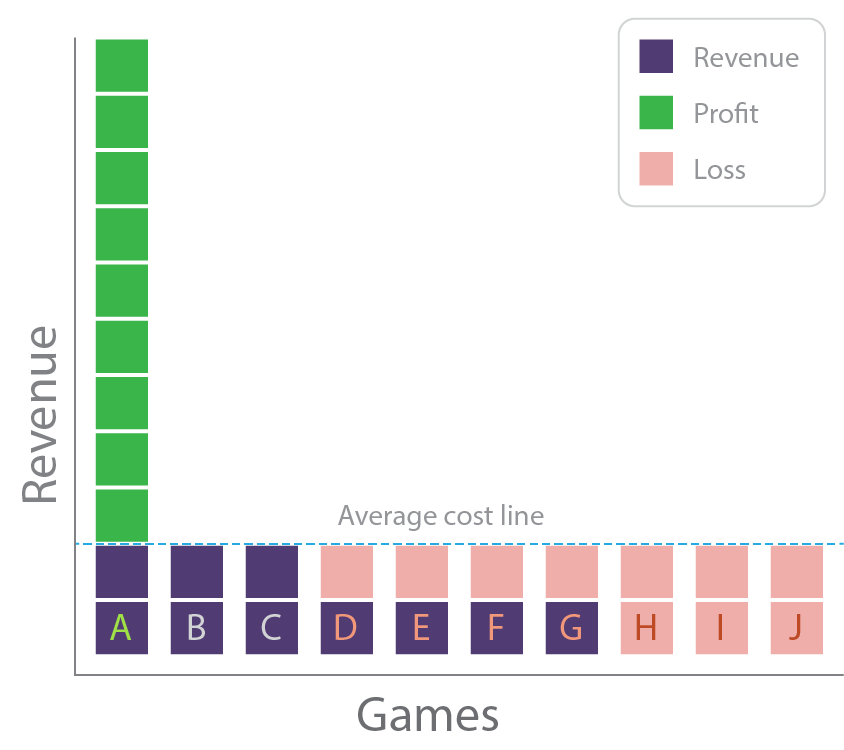
Variability – Games have the tendency to be lucky or unlucky, you need to be prepared to get unlucky and have multiple failures in a row.
Budgeting – When budgeting ask the following questions, How much do you expect to make? (Target Revenue) and What is the change of making that much money? (Success Rate)
Prototypes – Prototypes can greatly help with running through ideaas, prototypes cost dramatically less than a released game. Some prototypes only take a couple of days to create and by disproving bad ideas early you can put real money into games that have a higher chance of success.
Releasing on multiple platforms – Each time you release a game on a new platform, you get to roll the dice all over again at a much lower development cost.
Longer Revenue Streams
- Franchise – long term game franchise where sales come from promoting sequels or remakes.
- Eternal updating – continually update a game and making some noise about it
- Freemium – make a game service and build a stream of revenue.
Conclusion
Game development is hard but I’m slowly getting there….

Leave a comment